

Fellow Traveller talked to Saltstone Studios directors James, Thomas and Jess about our upcoming game The Hearth and Harbour.
Hello everyone! We hope you’re enjoying all the summer games parties – showcases and next fests galore!
For Story-Rich Showcase a few weeks ago, Fellow Traveller asked us a few questions about The Hearth and Harbour! For a little bit of context about the upcoming blog post, we decided the easiest way for us to respond was to record ourselves discussing the questions, and then transcript them. Reader, this was not the easiest way. James and Thomas in particular (we knew this already) are enormous chatterboxes, and the final recording was about an hour long, or 18 A4 google docs pages. I managed to cut it down to about 8 pages, and Fellow Traveller cut it down even more to be reasonable for any person to read.
The final Fellow Traveller interview is available to read right here on their website.
BUT, if you’re a weirdo and you love to read long things, I thought it could be fun to share the 8 page version here on this blog. It’s about a 20-30 minute read, so make a nice drink and get comfy before you get stuck in.
The video recording of us discussing the questions is right here. It’s not very exciting to watch, but it might make good listening material if you’re a podcast enjoyer, or if you’d prefer to hear 3 people talking than read a big long blog post!
Relevant characters:
Fellow Traveller (FT) – interviewer, publisher
James – sound designer and composer, game director for Hearth and Harbour
Jess – art director, marketing
Thomas – development director, narrative
FT: Hey team, it’s great to have you with us! Firstly, can you tell us how the idea for The Hearth & Harbour came together?
Thomas: Well, James has a professional history in the service industry.
James: We wanted to have a mechanically cosy experience that just had a little more narrative edge, more depth. And the game being set in our universe was quite important. I think that it has given us license to sculpt the lore into this more meaningful thing.
Thomas: I specifically remember that The Pale Beyond was based on several expeditions, predominantly on Shackleton’s Trans-Antarctic endurance expedition, and the account by Alfred Lansing. And one of the most notable aspects of that was that all the crew survived, against all odds, only to miss the first half of the first world war, come home, and immediately sign up and die in a trench for no reason at all.
So there was discussion about us initially maybe doing something related to the first world war, but the team didn’t want to do something that was inherently combat-driven, with mechanical violence.
Jess: I think our version of a war game would be Blackadder season 4, just people hanging out in the trenches.
Thomas: With Pale, we realised that the secret sauce is the fact that every character is fully fleshed out and not just faceless. So given James’ experience in hospitality management, we thought a more interesting, and otherwise less covered angle of a game set during a war, would be what happens to civilian populations – the effects on just the everyday person.
James: At a very surface level, there being a war going on makes for interesting mechanics. It changes the availability and the price of things, and introduces things like rationing and differing attitudes about the conflict and the politics that surround it.
Thomas: I think I was particularly interested in trying to consider how we could deliver the idea that every customer is actually a character in the city, without scoping down. We’re retaining a relatively high customer pool, but still delivering on their characterisation. And through the characters, slowly painting a picture of a city and a culture.
Jess: James mentioned something about being at least a little inspired by cosy games. We didn’t set out to make Pale a cosy game at all, but we found that people felt it was a bit cosy to be on the ship at the start. But it was only cosy because of the contrast. If the whole point is that you’re creating a space for people to feel welcome, which is the point of the restaurant, that only matters if there’s something that sucks, to be cosy against, if there’s contrast there.
Thomas: Yeah, you need a blizzard outside for your mug of hot cocoa to feel cosy.
James: I think that there will be a really interesting and slightly surprising video game at the end, honestly. We had to fight really hard for the right and the space to do what we want creatively. I quite strongly feel that you don’t get to choose whether you put yourself and your experience in art that you make. It just is. So I think there’s something special in there with Hearth, sincerely.
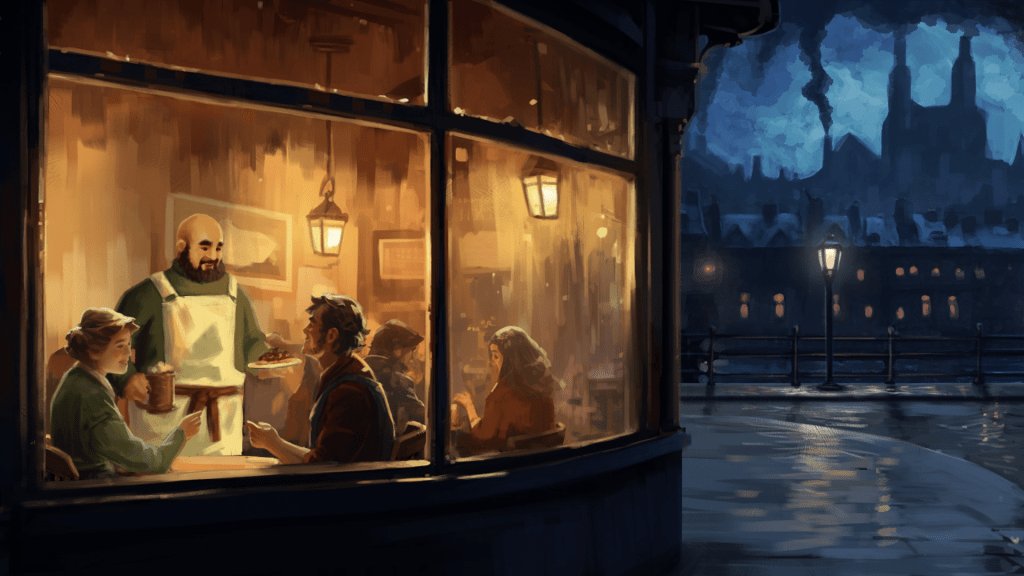
FT: It’s no secret that running a restaurant in real life takes a lot of work and dedication. How have you translated that experience into the game?
Thomas: So, I’m coming at it from more of the angle of trying to keep a small business afloat for most of my 20s. I’ve been going out of business for ten years. I’ve worked in hospitality but mostly as a tour guide or in clubs – James has a lot more direct experience in the actual food service industry.
James: It’s almost a misnomer to call it the food service industry, it’s the people industry really. You know, you can go anywhere and have a beer. I think when you go somewhere that’s special and interesting, it’s about the experience – the staff and the ambience and the set up of the room, it’s all designed carefully to make you feel comfortable and worth spending your own money on. Come in, you know? Do it! Oh my gosh, you’re absolutely worth treating yourself to a negroni at lunchtime, do it, girl!
So, finding ways that we can make sure that the ‘people’ bit of hospitality was at the forefront was really important to Hearth. Also, what it’s like to actually run a business, which is – you’re always downstream from things out of your control. It’s about being able to be agile and move and adapt to a situation. A way that we’re expressing that is that it’s about developing relationships – with the vendor when you’re buying stock, and then mirrored, with the customers. How those relationships develop gives you access to social threads to pull, and maybe you’ll have workarounds for some of the world’s problems through the people around you.
Thomas: A lot of the more technical nuts and bolts design is following on from what we learned when we did Pale – specifically the loyalty system. In Pale, there was a voting system at the end of the game, where it felt like there was a nice marriage between the choices in the narrative and the resources. We’ve tried to keep that same approach in The Hearth and Harbour, although I would say the macro structure of how those systems feed into each other is a different shape. The Hearth and Harbour has all these modular bits – money and recipes and how you design your restaurant and favour with characters – that you build up over the course of the game to build up to a final pay off, where it feels that everything you did, whether it was a dialogue choice or a resource trade-off that you made, ha added to the final outcome. It’s something people really liked about The Pale Beyond and it’s something we’re trying to do in this game as well, but in a different way.
When it comes to specific mechanics, we spent a lot of time chatting to a lot of people in the local hospitality industry in Belfast. It’s actually been very fun interrogating people, being like ‘go on, tell me about your best and worst customers’ and all the customer stereotypes. And we’ve tried to take some of that information and put it into the game loop, so that the characters feel distinct from each other, and the way they mechanically operate in service feels like it’s actually represented in their underlying character, as they’ve been written in the script.
Jess: Stress. We put burnout in the game, which feels like a fun prank that we’ve played on ourselves.
Thomas: I think that it’s a miracle that any game ever gets finished ever, but all three of us at different stages have certainly dealt with the effects of stress, and the management of stress.
Jess: You can die from stress in the game. If you get too burnt out you lose all of your action points and you die.
Thomas: Yeah, you die of a heart attack. Despite not wanting to make a combat game, the way service operates is effectively a combat system – but instead of health and killing things, it’s all about stress accumulation and that resulting in positive or negative favour outcomes with customers. Again, that feeds into the war theming, what happens when your entire customer base starts to come in more stressed because of what is happening in the world that you have no control over? How do you adapt your strategy to not just look after your customers and make sure they have a good time but also to look after yourself. I think anyone who’s worked on a small team under deadlines with limited resources will be able to kind of find something in there.

FT: Can you dive into the process of creating the game’s protagonist, Kit Purcell? What elements go into making a compelling player character?
Thomas: The biggest difference with Kit from the protagonist of our last game, The Pale Beyond, is in Pale you never saw a visual representation of your character and you’re in that roleplaying grey area, of being able to sort of imprint on a slightly more abstracted out character.
Whereas here, you can literally see who you are – and you’re able to move them around as an avatar in a space. I think after trying to develop the character initially as a blank slate we realised that we needed inherent dramatic stakes that tied in with what we were trying to say about the world, and what the underlying messages of the game were. We settled on you being an immigrant to Lewthport – fake early 1900’s Belfast, and you’re from fake Germany, Grauberg, during fake world war one. We did a fair bit of research into what was the experience of Germans in the United Kingdom and Ireland during the first world war.
I’m someone who moved to Northern Ireland when I was eight or nine years old, and I think if we’re designing a city based off a lot of local history, we take some things for granted because we’ve lived here our entire lives. But if we’re trying to share this with the world and have people basically come and visit a simulacrum of our city, I think Kit being an immigrant is a handy way of both providing dramatic stakes that are relevant to the plot, and also the fish out of water perspective that allows us to onboard and align the player’s lack of knowledge about the area with the character’s lack of knowledge.
FT: The game centres on the player’s agency to make decisions that impact the wider community. Without spoiling too much, can you give an example of this happening in the game?
Jess: Every character that can be a customer in the game is somebody that you can form a relationship with, and develop friendships with. They all have their own kind-of-questline where you as the player act as a confidante to them as they navigate a problem. Some of them are more self-actualisting, but there’s one that was teased in the trailer a little bit that is very affected by the macro narrative. It’s this very boisterous young man who’s very patriotic, and he’s excited about the war and he’s going to these soldier training camps and getting ready to fight.
Thomas: Yeah, he doesn’t know you’re from Grauberg.
Jess: You can tell him, but he doesn’t know where you’re from. He’s very much like, “Ahh, I hate those guys, I’m gonna go kill a bunch of Grau,” and you as the player get to say what you think about that. But the manifestation of his questline is – he develops a friendship with one of the other boys at the soldier camp, and thinks, “This guy is not gonna make it through the war, my friend is soft, he’s not gonna make it.” That eventually culminates in his friend and himself trying to dodge the draft. Which is a big deal, it’s a crime, and you as the player are given the option to help or not help him.
Helping him might put you at risk – if your restaurant is searched for example, you could get in massive trouble for hiding a draft dodger. Your past as an immigrant could be exposed, so it does put you in danger to help this kid, but if you don’t then he will get sent off to war, where his fate is variable. He may or may not survive.
Thomas: I would also say, apart from those more narratively defined moments, the most agency the player has when it comes to decisions that impact the wider community is in how they spend their time outside of service. Who are you going to spend the precious time you have outside of actually doing your job getting to know more? How are you gonna be priorisiting your menu and the design of your restaurant around specific characters? But we have a bigger cast than the players necessarily going to have the chance in a single run of the game to fully get to know. So I think the real decision is gonna be which sort of community are you building around yourself specifically?
Jess: It’s who you choose to invest your time into. You could be sort-of-friendly with a lot of people, or VERY friendly with a few people, you can stack your favour in different ways.
Thomas: The real challenge is – have you integrated with the local community well enough to save your own skin?
Jess: Are you well liked enough that people will have your back, or not?
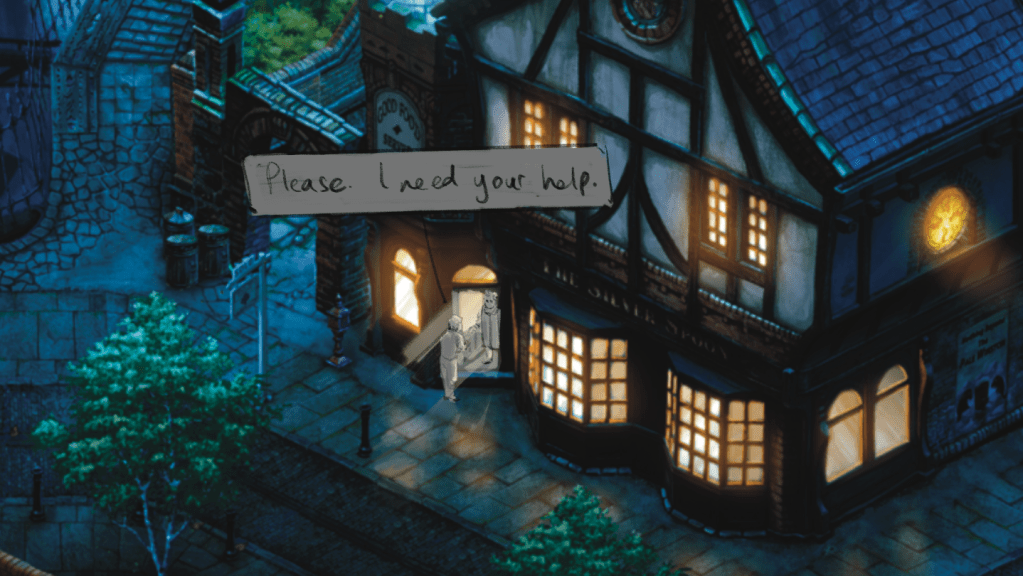
FT: The story takes place in the seaside harbour town of Lewthport. What are the qualities of the town that make it special and unique?
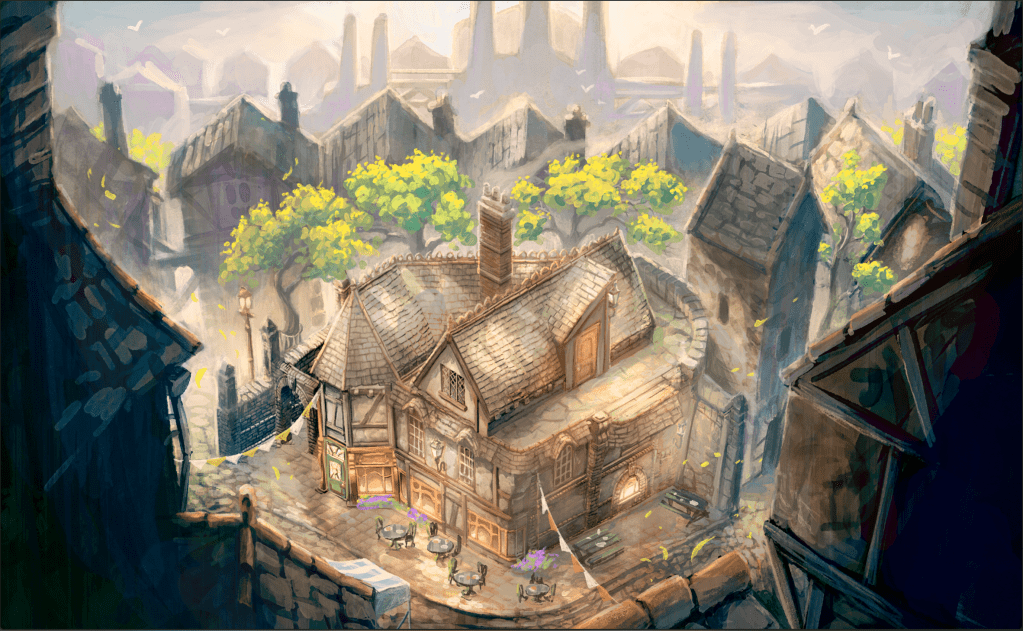
Thomas: I was at the Ulster Transport Museum on Saturday, and I saw an early 1900’s tram from Belfast, and recognised it and went ‘That’s in the game! Ethan (our environment artist and game designer) put that in the game!’ Loads of Lewthport is designed as a fantasy version of 1900’s Belfast, which is a port town.
James: In the very beginning, Ethan and I had long conversations, namely about two cities, which were Belfast and London. One of the exciting things about London for us was the fact that you can see these layers. You can look at old walls and you can see right down into the medieval layer. You can see how this city was just built upon over and over and over. There’s been settlement there since Londinium until the greater city of London now. And being able to experience the history passively just by it existing as part of the space was something we really wanted to do because that gives depth, you don’t have to tell that you just show it.
And Belfast was a city that boomed particularly during industrialisation. It fundamentally changed not only the shape of the city but the shape of the country around it. We wanted to show that, and part of that is that really cheesy phrase, “the city’s a character”. I think, in the environment designs, there’s this mixture of the new and the old – more relaxed pre-industrialised living butting up against the factories and the machines and the chimneys of the modern world.
Thomas: Belfast is this kind of paradoxical place where it exists in this mid-point between a city and a glorified big town – it’s a city with no anonymity, everyone literally knows everyone by like two orders of connection. It’s one of my favourite parts of Belfast, and when it came to some of the character writing, we wanted to exemplify this implication that if you make a splash, everyone knows. Everyone does know everyone. Everyone might not LIKE everyone else but they do know everybody else.
We also realised that we had enough of a city that we could actually give people permanent locations around the city – have the city feel full of life and full of people to discover, then invite to your restaurant and then develop relationships with. It made the whole city click, and I think it’s been cool in that the various locations around the city, and especially the various sub-locations and hang out spots, feel inseparable from the cast of characters.
Jess: Being able to explore was one of the defining features of the original design, that’s why there’s a player controller.
James: Yeah, to be able to explore, to be able to get lost, so be able to find little things that are maybe off the beaten path and meet people you wouldn’t expect to.
FT: The Hearth and Harbour is set in the same world and time period as your previous game The Pale Beyond. What led you to connect the two games, and how are the two different and alike?
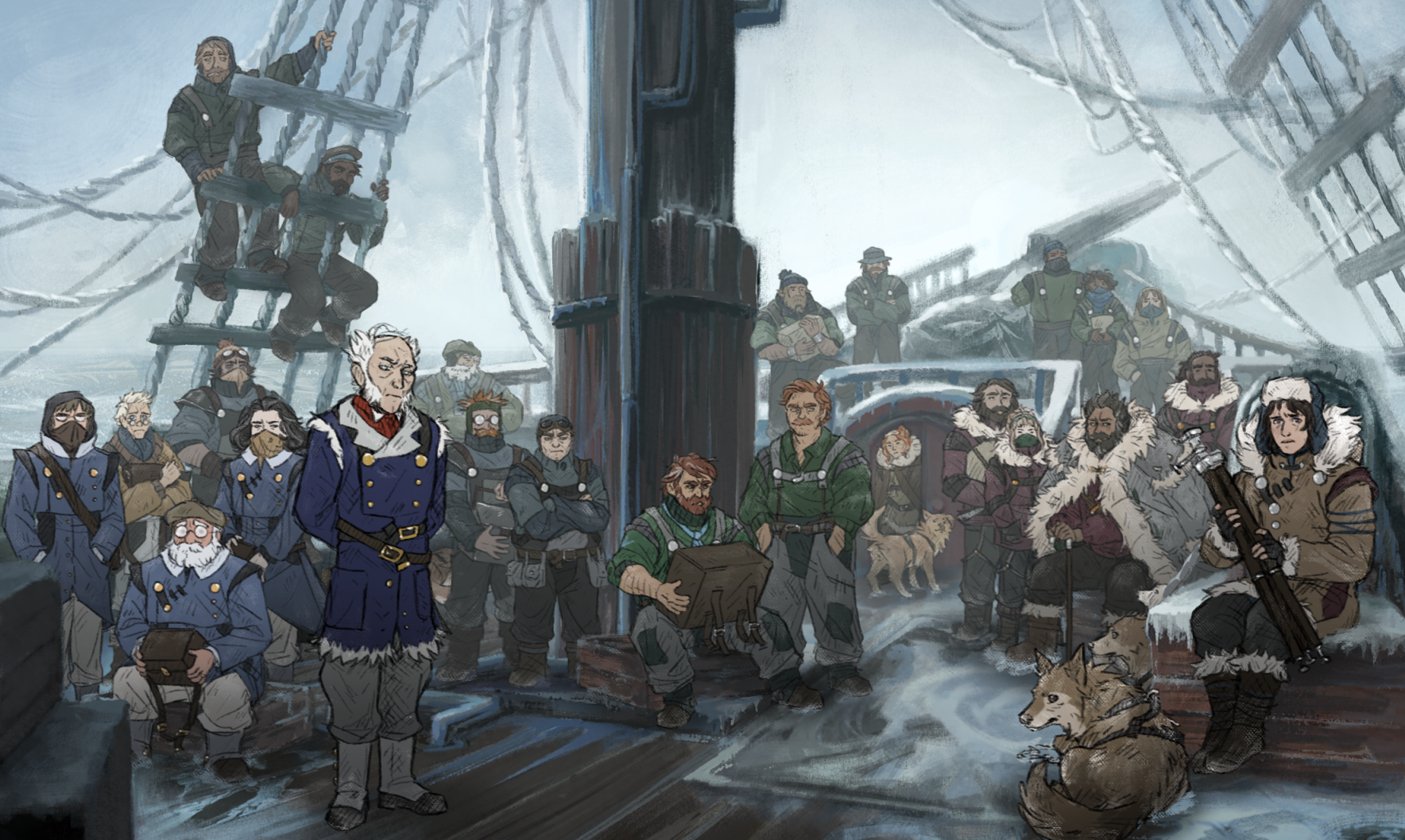
James: There’s a lot about Hearth and Harbour that is very different, and in fact, in a funny way, completely mirrored to Pale. At the start of Pale, you start with the most you’re gonna have, and it’s this war of attrition, and as entropy’s arrow steadily sinks lower and lower, you eventually will end up with the least you’ll have at the end of that game.
In The Hearth and Harbour, you’re arriving new into a different kind of scary environment. A city is comparable to the ice in that the ice doesn’t really care that you’re there, and when you’ve just arrived, the city doesn’t care that you’re there, you’re this little minnow in a huge pond. But the interesting thing about Hearth versus Pale is that in Hearth you start with nothing and the goal is to build this thing versus starting with everything in Pale and seeing how long you’ll get along.
There’s this moment at the start of Pale where you leave Lewthport, you leave this city, and a thought that passed through most of our heads at some point was, “What’s that city like?” And what does that tell us more about these characters? How does that place – that some of the characters in Pale are from – inform the different cultures that we see in The Pale Beyond? What questions can we answer that exist for us and also for players? We thought about how we could answer them without literally sitting down and making The Pale Beyond 2, which was not something we wanted to do at this stage. And I think looking at the cultural base, how they socialise, the music, the architecture, the food – in a way it makes Pale a deeper experience, because of the existence of Hearth and Harbour.
Thomas: I mentioned it earlier, but for me especially the biggest connection is the fact the guys on the expeditions we researched missed the start of the first world war. James is right that a lot of the design of this game is trying to invert patterns in Pale. In Pale you start with that same cast of characters and then the narrative structure fans out, but is always on a fundamentally linear arc. Whereas in Hearth, you have a more lateral smorgasbord, and it’s the players responsibility to pick and choose and build and grow from that.
Jess: Yeah, nobody’s stuck on the ice with you in this one.
Thomas: I think a city is about as far as you can get from an Antarctic desert thematically. There’s too much life, people are living on top of each other. In Pale you’re stuck with these people – in a city, people are a little more discardable. The fact that Kit has to go out and actually build these connections from nothing, and follow it up with being good at his job and creating a lovely third space for the community to inhabit during a difficult time, I like that it’s an inversion of the last game.
FT: Apart from Kit, is there a member of Lewthport that you’re most excited for players to meet?
Thomas: I am a big fan of the grave digger because he makes horrible puns about gravedigging. I genuinely think I’m excited about most of the cast.
Jess: The grave digger’s fun because he tells you about all the horrible ways people die in different locations in the city.
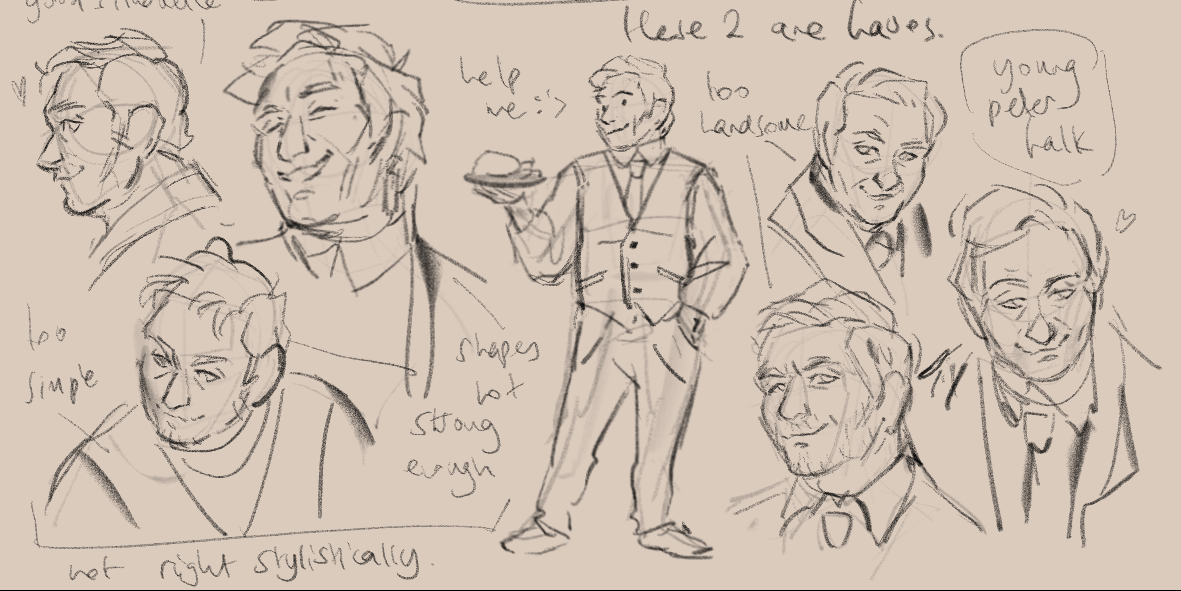
James: The handsomest milkman, nice but dim. He wants nothing but goodness and kindness for everybody, so he’s very easy to forgive.
Thomas: I don’t like them, but I love the writing of the scenes they’re in – of the rent collector.
Jess: He is the villain.
James: I think in a funny way it reflects a little bit of that Templeton stuff.
Thomas: I think he’s a LOT less redeemable than Templeton.
Jess: I’m very excited for everyone to meet the poet. He’s this really pathetic discount byronic character. I don’t even think it’s possible to offend him because he just assumes that you’re being nice to him all the time. You can be super mean to him and he’ll interpret it as a compliment.
Thomas: Eric achieved something that’s very difficult to do for the writing of the poet, which is to authentically write someone mis-using vocabulary thinking they’re being smarter than they are and it not coming across as just bad writing. I really like the poet. I’m in this picture.

FT: Through the game’s favour system, players can learn new recipes and open new opportunities by helping the townspeople. Why was it important for you to tell a story about community and its importance during times of strife?
James: Literally, it’s how we survive. Everybody, whether you believe it truly or not, you’re part of a community, large or small. You don’t even have to like everybody in your community, you don’t have to see them every day, but we live in a society, and we contribute in some fashion, positive or negative, always. I think every story is accidentally or deliberately about community because it’s how we exist. I think it would’ve been quite difficult to write it not about that.
Thomas: It’s also no coincidence that between making the last game and doing this one, we have moved offices and set up a co-working hub space for the games industry, especially during a time when funding is pretty tight. Ourselves and other game dev teams and production companies, we’ve literally banded together in order to help each other.
James: Weather the storm some. And we touched on it before – how it’s nigh impossible, to not have your voice and lived experience appear in the work.
Thomas: Oh no, we made a community hub and then a war broke out. Ahh.

FT: And last but not least, what is your favourite restaurant to dine at?
Thomas: That’s extremely serious. We’re going to disagree about this.
James: As a group of people who decided to make a game about food and running restaurants, it’s actually a very serious question. One of the most important things I learned from working in hospitality was, we’re selling an experience, we’re selling a feeling. You know that sigh you do after a good meal, after you leave, and the cold air of the carpark hits you and you’re like “I can’t wait to tell somebody about that?” That feeling.
For me, there’s a couple of restaurants in Belfast that are pretty special and pretty important, but one of them is this modern Italian place called Coppi. It’s a simple menu, really experienced good staff, excellent food and impeccable wine list.
Thomas: There was a Korean barbecue place in Amsterdam that I think about every week. In the same vein as that, I think one of my favourite restaurants – not even because I think it’s got the best food ever, but because it’s the restaurant I’ve probably got the most positive memories associated with for a period of time – is probably the old Chinese buffet we used to work on top of.
James: That place is pretty special, and it has that nice combination of really good quality food, nice but rude staff, and they’re open til like 2 o’clock in the morning.
Thomas: Yeah and they have a secret karaoke place I’ve finally since been to.
Jess: Camille Thai do a beautiful vegan green thai curry spice bag and it rocks my world. Anytime anyone visits the city like, if they’re from somewhere else I always bring them to Maggie’s. It’s the quintessential Northern Irish place, where it’s all breakfast food, all day, the hangover cures are marked on the menu, and all the staff are mean to you.
Thomas: We do pints and we do breakfast food, and the seafood is actually pretty good. St George’s market, 2 quid for 2 fresh oysters. Hangover cure.
James: Not a restaurant, but Kelly’s Cellar do bowls of stew in the first half of the afternoon, and it’s the simplest thing, and just a pint of stout and a bowl of stew, and it’ll make your day.
Jess: It’s worth saying that Kelly’s Cellar is like a thousand years old. You feel like you’re a peasant coming in from working the fields.
James: Yeah, there’s a reason that has stood the test of time, it’s still great, you know.

See you soon!
– Jess (Art Director)
FANART FEATURE:
On our blog posts, we share artwork created by our lovely community! We’re so grateful for your passion and support. We’re posting this at the end of June, so we have a pride post squidged in there just in time!!

Artist: Birbwell
“Happy pride!”
Links: Birbwell on Bluesky / Birbwell on Tumblr
If you would like your work featured on our blog and social media, contact me:
Email: jess@saltstonestudios.com
Discord: jessanight
Thanks so much for your support, from The Pale Beyond to The Hearth and Harbour, and hopefully, beyond.

