
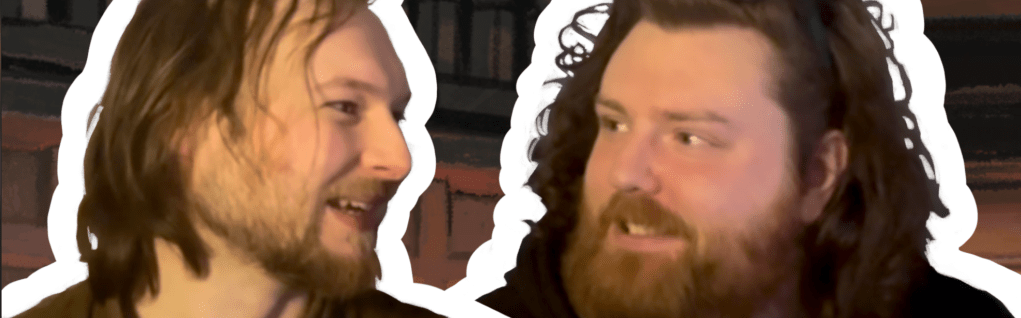
An Interview with the game designer and game director about our upcoming game, The Hearth and Harbour
Hello again! Welcome back!
On our first day back to work, I sat down with James, our game director, and Ethan, our game designer, and asked them a series of questions about the design of The Hearth and Harbour. It was a bit chaotic, but between the two of them, they were able to provide some insight into game development as a process, as well as their personal philosophies on art and the themes in our games so far.
This is the second half of that interview, about the game The Heart and Harbour and some of its themes. The first half, focusing on their roles within the studio and how they think and feel about game development was in part 1, last month’s blog post, available to read here.
IIf you’d like to watch the entire, less-edited interview, both parts 1 and 2 (about 1 hour 5 minutes, lovely background noise), the video is available here:
And there’s a full transcript available: here!
Relevant characters:
Jess – interviewer, art director
James – sound designer and composer, game director
Ethan – environment artist, game designer
Thomas – development director, interview peanut gallery
Jess: Why a game about running a restaurant?
Ethan: If we’re honest about The Pale Beyond, not everybody chose to make a game about an Antarctic Expedition. And with this restaurant sim, not all of us voted to go and make a restaurant sim. So what we have with The Pale Beyond, and this project, is people who have loads of interests, who have a lot of specialties, things they’re obsessed with… thrown into an in-media-res sort of place.
How’d I end up here? How would I make The Pale Beyond? We come from all these weird angles at a thing – where are we going to find the fun in this? How would we do it, coming from a completely strange direction?
Thomas: Well constraints breed creativity.
James: I think, if it had been a straight vote, we might be making something else. But it’s rightly pointed out that when there is constraint and you have to operate within barriers or gates you didn’t choose, that breeds really interesting and novel solutions to problems. And it’s something we found in Pale for sure. It’s not a situation that 100% of everybody would have chosen to be in, but the solutions were novel and interesting and led to, I thought, a really engaging and interesting video game. And I think we’re sitting in a similar position now, where a lot of the solutions are coming from, a place of… people that maybe aren’t embroiled in the genre, but instead, are coming at it from, “okay, well, what’s interesting and novel about this exact setup?” It’s not what are the genre conventions? It’s rather, what would we do?
Ethan: Yeah, there’s so many genres and types of game you can make that you could accidentally make a new hybrid, just by accident. A few creative decisions could just completely transform a genre with video games. We could say “I’m gonna make a visual novel about a restaurant and running it”. But I’m more excited about being in the city and walking around it. So if you can walk the streets, and you can come across things at your own time, and not just by clicking through dialog, that gets me excited about being in this place and meeting people in it.
I want things from other genres. I want to have the feeling of place and geography, and I want to look at buildings and know, you pick up the history in a game, which could be very, very exposition heavy, a lot of people telling you things. I love to be able to just look at the world we’re in, look at the city, and just get a lot of stuff just from looking at it.
James: Yeah, like show rather than tell.
Ethan: Yes. I want a lot more eye candy in my visual novel, if we’ve got to make one. I find that nourishing – the stuff that doesn’t require words.
James: I mean, the express examples are… whenever we were looking at building designs, that was particularly exciting for both of us. Because we both got kind of giddy – we love the way that London’s built. You can see the Roman and the medieval, and then the whatever is in between. And then we get kind of pre-modern, and then to the modern stuff. But everything is just directly built on top of each other.
Ethan: Sedimentary.
James: Yeah, and you have these beautiful, really distinct layers. And I know we’d had those initial conversations right at the beginning that, “oh, we have to include this”. This is fundamental, to give a place deep roots – you see them because you can see the layers of the walls, you can see that some road parts are kind of really old cobble and other bits – you can see where it’s been patched and repaired loads of times. So it gives it weight.
Ethan: Yeah, you gotta believe that it existed before you started looking at it.
Especially in a digital medium, because if you do everything clean and perfect, straight and not jagged or like askew, it looks fake. So you really got to amp up the texture, the dirt and the character imperfections, – just to break out of the medium of I’m looking at a screen with squares and colors, fills and stuff.
James: It’s gotta be a bit off grid and a little bit wonky like that. I think that’s where a lot of the interest lies.
In a funny way, with the music as well. It’s very easy, especially with writing on the computer, to get locked into everything being perfectly quantised and perfectly in time. But I think that things become a lot more interesting when there’s a bit of flex and move. And much like we might have a slightly crooked building that overhangs the street slightly, I think it’s interesting whenever we maybe have a little bit of space hang for a little longer than a beat, or we have a note hang on for just a little too long, because at the end of the day, it’s how it makes you feel, rather than it being exactly perfect.
Ethan: Yeah. You don’t want it to sound like there was too much machinery and too many automated processes creating the music. You wanted to sound more like a real player was playing it. Maybe they stayed on the bar slightly longer because they were listening to another player.
James: Exactly. So it’s all, you know, feel and flex and move and, yeah.
Jess: I think it’s true of any job – like professional work – that you don’t have control over what it is that you’re doing. But what is it about the game’s design that got you excited? Like I’m starting to feel like what we have is something really special, or I’m starting to feel like it’s coming together and we can see what we’re going for?
James: I think it felt like the answer was kind of simple for me. I love whenever media of any kind asks questions of the audience, it asks you to put your flag in the sand or whatever, and define what you think about a thing. I think that’s interesting and that’s challenging, it’s cerebral and it’s intellectual, and these are all things that I profess to like, right?
But I think one of the questions that came up in The Pale Beyond was… what is the rest of the world like? And I feel like, in The Hearth And Harbour, through the medium of a restaurant-y kind of game, we have this really wonderful opportunity to show the wider world outside the microcosm (of The Pale Beyond).
You’re in this position (in The Pale Beyond) where the number of people, the number of characters you have to interact with slowly whittles down over the course of the game, and things get smaller and less, and the barren wasteland cares about you less and less. You’ve less supplies, and as you near the end of the journey, it becomes about who survived, and this all culminates in this kind of final game moment.
In an interesting way, I felt like Hearth and Harbour was, at almost every point, the exact opposite. You know, it’s about arriving somewhere, and there is lots to find and discover. There is a community to build, as opposed to that you’re starting with one. I think everything that happens in The Hearth and Harbour supports the world that The Pale Beyond exists in.
So certainly, for me, at a conceptual level, I was already sold on the idea, because I loved the idea of, “oh, cool, the city we leave at the start of The Pale Beyond – dope, we get to arrive there and see a different story, a different setting”. And, you know, from an artistic perspective, it’s drastically different.
Ethan: Yes, and by taking the time period that these Arctic expeditions were in their heyday, just before the First World War – there’s a lot going on. We were able to take that setting, and rather than it just be an homage to Pale Beyond, it’s instead… lots is changing in this world. It’s becoming more industrialised, and there’s this old world, and there’s a lot of beautiful things being made, but there’s this dark cloud hanging ahead, and things might not be good for too much longer. Things might be too expensive. There might be a lot less of a world of beauty and art and nice food, and more rations and propaganda posters and all this stuff changing. Really we can start having some thematic focuses here, in this time period.
And it may be an alternate universe to ours, but it sure looks a lot like what’s happening even today in the world, where there’s a lot of changes, and our audience live in this world too. We’re making this game with these themes for us who exist right now.
James: It feels to me like one of the overarching themes was the world, from like 1901, the world starts to get smaller every year, and it never stops getting smaller, until now, where for the cost of, like, an expensive lunch, we could fly almost anywhere. I think that that’s a fascinating period to look at, that beginning of the shrinking of the world. I mean, you mentioned that the process of industrialisation, we move from a place where every chair you buy took a week because the guy at the lathe did it by hand, to then a short number of years later, 1000 chairs a day out of a factory.
Ethan: Yeah, and the trades are gone, and we all have to look at the new factory made chair and say, “well, that’s as good as anything’s ever going to look ever again”.
James: So there’s something about gentle appreciation for the slower, more handmade, kind of the time before. We’re not strictly saying that new is bad, because new isn’t always bad. I guess it’s more of, let’s take a beat and appreciate what was before we rush off too quickly.
Ethan: Well, we’re trying to thematically tie the way things are made in general, to say, the old markets and everybody providing the food on a face to face basis, that this is the baker. You look him in the eye, you buy the food. It’s not a supermarket. It’s we’re trying to contrast this little fantasy early 1900s world contrast to today, a world of mass production, plastic, metal. We’re going back in time where everything’s hand carved, hand rolled dough, the fisherman’s right there selling you the fish.
James: Yeah, you feel like you have more of a chance to know the artist or know the creator, know the person.
Ethan: Yeah, and you can leave your house and walk to the market. Some people today, they live in a suburb where they can’t leave unless they have a car and they go on a highway, before they see a single business. They live on a satellite Space Station, basically. Hopefully, emphasizing those themes in the city of Hearth and Harbour, people wonder… Was that better? Do we miss that? Should we have some of that back again?
James: I mean, I think that comes back to what we were talking about. What was interesting to us at the start is, we want to ask questions of the player. If we can make them think about a thing in the same way that we thought about it whilst building and designing and working on the thing, that feels like a pretty good artistic achievement. I think that’s really interesting to me, and certainly it’s what I would get out of a lot of the art I consume – I want it to ask questions. I want to be challenged.
So if we can do a bit of that – class.
Ethan: Yep, can’t talk about a city without thinking of our own city right now. And we’re definitely going to think about what way do we buy food today? What way do we buy things today? What way did it used to be? Was something lost? Do you actually know anybody who made your clothes or your or your bread?
James: Yeah, there’s that little bit of separation between the act of creation and the act of consumption. In a funny way.
Ethan: Yep. Part of the world being smaller is that everything’s shipped abroad. It’s not made locally. You don’t have a clue who made it, and it might be someone on the other side of the world that didn’t get looked after very well by their community. What if you looked after everybody nearby and did the best thing for their business, and they did the best thing for yours? Could that work?
Let’s see if it feels good to walk every day to the baker’s to make your meals for everybody, and then you recognise everyone by name. How do you feel with that little thought experiment? Is that nice?
Jess: Unlike The Pale Beyond, Hearth and Harbour is designed a lot more mechanically-first than narrative-first. How did this affect the decision-making process or overall game design?
Ethan: Pale started out literally as just a visual novel, so what ended up happening in the story would drive everything. And so, having played that early version, we had to find the decision-making in the game design, and sort of graft it on after like a cyborg. It became more mechanical (afterwards).
And maybe as like a massive swing in the other direction, we were trying this time to start with systems first. If you’ve got this job every day, let’s make the job first. Open up your restaurant, go to the market, buy your food, set up the menu, serve all the meals to everyone, and all of that stuff, it’ll keep you busy for a long time making all that work. And we also had a sense of calendar, how many days are in this game. We needed a bit more meat on the bone to be confident we could fill out a story for long enough, with a bit more turn-based gameplay more often than we might have got in The Pale Beyond.
The Pale Beyond had worker placement, a bit like some board games might have, where you send a certain amount of crew off to do things each week, and then you skip to the next week, and then you gain things and it keeps you going – some light survival mechanics. This time, there’s currency, there’s items to buy, there’s shops, there’s vendors that have reputations, there’s customers that have reputations. You can try and fake that stuff and just have the story tell you it happens, but it’s so much more satisfying to build the infrastructure of that, and see the outcomes feeding in and feeding out. And each playthrough being a lot more divergent from other peoples’ playthroughs. I think we were just a lot more ambitious this time around.
James: Yeah, certainly. I think a lot of it came from just wanting to do something that felt different to do. I didn’t really want to do Pale Beyond 2 straight away, but it still didn’t feel like we were quite done being in that universe yet, so this kind of felt like the right style of thing, because it allows us to do something very different, but still lean on the familiar.
Ethan: Yeah. We could go, it’s in the universe of The Pale Beyond, because of course it is – but we can actually think of good thematic reasons to be in this time period, in this city. A lot of it can be a good canvas to explore themes we want to explore, and try new systems that we want to try. It’s good that it’s like a sort of fantasy 1900’s, that’s a perfect time to tell this story. We get to hit all these beats that were good about The Pale Beyond, and it gets to be about something a bit deeper.
James: And then the addition of like just a little bit more mechanical complexity, I think – hopefully that’ll furnish the player with slightly more game. I love The Pale Beyond and I’m incredibly proud of it, but at the end of it, I think all of us agree it would be interesting to try to do a little bit more. And just having a little bit more mechanical complexity I think sort of gets us there, certainly for Hearth and Harbour.
Ethan: Yeah. We owe it to ourselves too to challenge ourselves so that we can make more cool stuff. You make the best game you can, but then you actually get better, and then you can make an even better game hopefully. At the moment we’re just probably excited to make different games, and see what we’re capable of in different directions, rather than copy and paste all the time.
James: Yes, that might be faster, but it would be really boring.
Ethan: And we might not get better at what we do.
James: Well, what’s the Jim Carrey thing? You can fail at the thing you hate so you might as well try the thing you love.
Ethan: Yeah. You learn stuff even if you don’t hit the mark.
Love,
– Jess (Art Director)
FANART FEATURE:
On blog posts we’re sharing work created by our lovely community! We’re so grateful for your passion and support. This ones a shipping one – which we are very happy to encourage : )
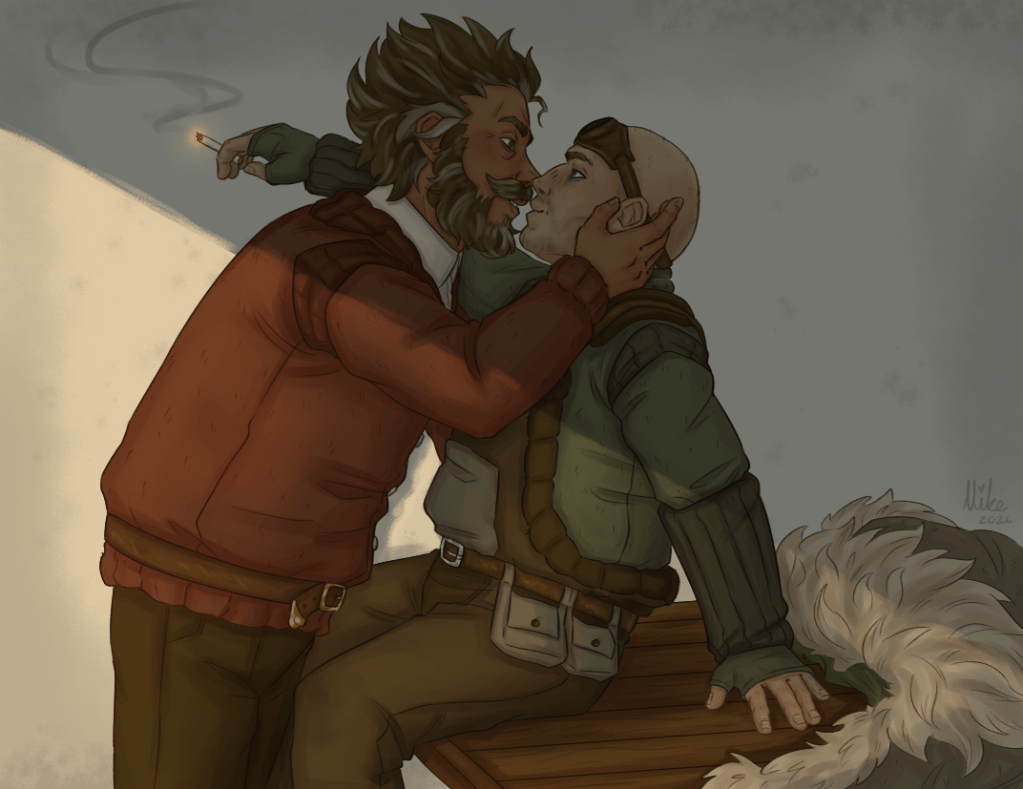
Artist: Niko
“coldest place in the world is a great place to find love :]”
If you would like your work featured on our blog and social media, contact me:
Email: jess@saltstonestudios.com
Discord: jessanight
Thanks so much for your support, from The Pale Beyond to The Hearth and Harbour, and hopefully, beyond.
 saltstonestudios.com