
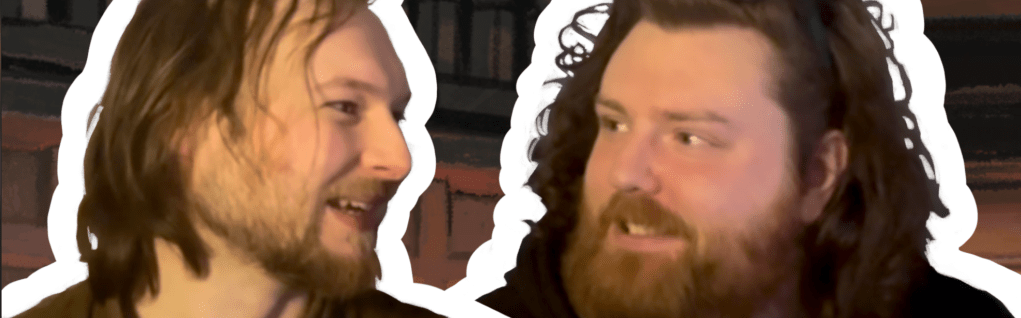
An Interview with the game designer and game director about our upcoming game, The Hearth and Harbour
Hello everyone! Welcome to a new year!
On our first day back to work, I sat down with James, our game director, and Ethan, our game designer, and asked them a series of questions about the design of The Hearth and Harbour. It was a bit chaotic, but between the two of them, they were able to provide some insight into game development as a process, as well as their personal philosophies on art and the themes in our games so far.
This is the first half of that interview, focusing on their roles within the studio and how they think and feel about game development. The second half, about the game The Heart and Harbour and some of its themes, is in part 2, next month’s blog post, which can be read here.
If you’d like to watch the entire, less-edited interview, both parts 1 and 2 (about 1 hour 5 minutes, lovely background noise), the video is available here:
And there’s a full transcript available: here!
Relevant characters:
Jess – interviewer, art director
James – sound designer and composer, game director
Ethan – environment artist, game designer
Thomas – development director, interview peanut gallery
Jess: James, how did you find stepping into the role of Creative Director for a new game?
James: Certainly a challenge. I think, quite sincerely, it’s one of the most rewarding work-related things I’ve ever done. But easily by a country mile, is the most difficult thing that I’ve ever done, ever. Period.
Jess: That’s big considering you used to work in hospitality.
James: Yeah, well, I think there’s a lot about hospitality that kind of carried over, especially with working with people, which is the bread and butter of the whole thing, right? But yeah, by far and away, the most difficult thing I’ve ever done.
I think it’s partly because you’re always balancing the expectations of others, right? You know, we’re communicating with the publisher, also communicating with each individual team member about their expectations- and everybody has different expectations. And we haven’t even mentioned the audience yet, which is the biggest group we’re communicating with. You know, certainly the reason that I buy games and buy records and buy paintings is because I’m interested in the artist’s voice. I want to hear what they have to say.
That collaborative part is key. I mean, this is, you know, riding the coattails of Thomas’ work – we have an incredibly talented team, and everybody trusts each other, and we’re individual fans of each other’s work. So it’s quite easy. (A game director’s) job is to grease the runway, right? It’s to make sure that everybody has everything that they need when they need it, and that they can take the path of least resistance to the best quality work that they’re that they are happiest with.
Jess: Can you tell us a bit about the differences between a game designer and game director?
James: It feels like the game director makes demands of the game designer, and the game designer makes it into a game, right? You know, I think we’ve discovered as a group that the game director role is as much administrative as it is creative, but it’s kind of looking at and facilitating kind of big picture stuff. Whereas it feels like the game designer’s role is; how do we action those big picture ideas?
Ethan: So (a game director) might say, this game is about being there for people and creating a hub for them, and that’s what’s first and foremost, and your relationships with everyone matter. But as a game designer, you have to make the systems. When we have to stay on theme, we use different mechanics to make the motivations different. Maybe the carrot and the stick – the rewards – are more for you know, caring for people, rather than buying more stuff or buying a machine to do all the things that, you know, make your restaurant fun.
Jess: Thomas pointed out that you (James) will refer to yourself as the ‘player advocate’, as the game director. Can you talk about that?
James: Yeah, I guess whenever we’re comparing the difference between game designer and game director, I think there’s a little bit of crossover. But I think the main thing for the game director versus the game designer is, the game designer is building these systems in the way that they see fit and, in the best way to adhere to the pillars, right? It’s to achieve the goals, but the game director’s goal is to be the player advocate in the room.
You know, like we’re a room of clever people, or we like to think that we’re a room of clever people. But the most dangerous thing I think, for clever people to do, is to get excited about being clever.
Thomas: (laughs)
James: Yeah, some other clever people in the room. So, I think it’s really important to have a player advocate in the room, someone that’s always thinking, “is this actually fun?” The solution to problems doesn’t matter so much, like the player doesn’t mind or care how clever a solution to any problem that we’ve come across is, they care whether they’re going to fall through the floor, or whether the buttons work, or whether they’ll clip through a wall. The player doesn’t mind why or how we’ve done something, they just matter how it feels, like that’s the thing that matters.
Ethan: And it’s also good to come back to what your pillars are, what your game’s supposed to be about, because there’s no best answer for all games. It’s like, what’s the best answer for this project?
Jess: I think if we were making a different game we would come up with different answers for things.
Ethan: I think everybody should take that home with any creative project they’re working on, that there’s no, “that’s good, that’s bad”. It’s like – is this appropriate or is this not appropriate for what you’re making?
James: Totally, it’s not, it’s not good or bad. It’s right or wrong.
Jess: It’s worth maybe exploring your (James’) role as a composer and the person that decides the tone of the game, how that affects your role as creative director, if those things feed into each other?
James: In an interesting way, the composer work has helped less than coming from a hospitality management place before, getting into games – or certainly while I was making the transition and freelancing for a couple of years and stuff. Like, hospitality is all about your crew and your team, that’s the whole gig. There is no cafe owner that does it all, that doesn’t exist. So that, as an industry, has always been about building this team of people that you trust, and that’s the key. And I think in a funny way, video games is the same, right?
I think, much like whenever you’re building a team in hospitality, whenever you’re working with a team on any mixed media or multimedia creative project, trust is the main thing. I think that’s one of the things that we achieved really well as a team when we worked on The Pale Beyond, was this constant cross communication between departments. And it’s something that Thomas fostered whilst directing that game – was this love of the loud office, of people always talking, every department’s always talking to every other department.
And in a funny way, coming into the directorial role, I feel like I brought more of that from hospitality, from anything else. Just because it’s that mix of people, all from different backgrounds, different outlooks on the world, but we’re all trying to point our furniture at the same TV, you know, we’re pulling in the same direction. We’re trying to make the same thing. And I think it’s such a huge part of that is just… trusting each other.
Jess: Have we accidentally made another game about running a games company?
Ethan: Yes.
James: Yeah, every time. You make what you know, right?
Somebody asked me that recently, about voice in your work. Whilst talking to people that have played Pale, I think we as a group, had an idea about how obvious we were being about, you know, our political positions. We’re a group of progressives, and we live in this post conflict society, and so that’s all quite normal for us, because we live it every day. But seemingly it comes out very clearly in the work. And it crystallised for me that your voice coming out in the work is kind of unavoidable.
And I think that that’s part of that trust thing, right? I trust everybody in the room’s taste and their voice, and I’m fans of all of them individually, yourself (Ethan) included, of course. The people that we are and the things that we think and the things that we love and the things that we care about just… comes out in the work, and you literally can’t help it, because your voice is your work.
Ethan: I heard something somebody said recently that really stood out to me, which is that – it always matters who’s making the thing. I have grown up a lot wanting my work to speak for itself. But really what’s more important, like we were saying earlier, we’re making a game about this, so how good is what we’re doing? Well, who are we and what are we saying? How well are we expressing ourselves? And that’s the mark of the quality of something.
James: I mean, we’re playing for feels, right? You know, like playing for feels is the whole thing. I suppose it comes back to like, the cleverness thing. Like we could be the cleverest, or we could come up with the most novel solution to problems. But players know if stuff feels right. They know if stuff feels sincere. They can tell if a developer cares. So I think just reminding ourselves all the time, trying to be the player advocate. I think that’s something that I try and remind everybody of all the time, is that we’re playing for feels.
Jess: Do you want to talk about making a game about running a business but not incentivising profit?
James: It’s so interesting. That’s something that rattles around in my head quite a lot, because I don’t think it’s a game about running a business.
Ethan: No.
James: And I know that it is – literally – a game about running a business. Like, I do get that, I’m not out to pasture here, but in my mind…
I used to run the whiskey bar at a hotel in town, in a popular area, and it was busy, but it became really apparent really quickly to me that nobody was coming in because of the whiskey selection that I chose behind the bar. People were coming in because they like the staff, because they like the music, because they like the comfortable chairs, because they like the ambiance, and most importantly, they like the feeling of being there.
And so in a funny way, because this isn’t a game about paying your tax on time and worrying about profit margins. You know, there are other games that do that, like really deep management games. This is a game more about designing the feeling of a place.
Ethan: Yeah, you’re making a place. You’re like, almost terraforming a little habitat for these little guys to come in and look after them.
James: And that’s the thing, I think that feels truest to me whenever we look at the the day to day, the way that people – outside of the administrative stuff – actually run a business. It’s about fostering your community and helping them have ownership over the place, helping them feel comfortable and view this place as part of the community.
So interestingly, I do appreciate that, yes, it is technically a game about running a business, but in my mind, it’s more about the kind of… social juice that happens whenever just people are together.
Ethan: Thomas has talked about it being a third space, which I think is a thing that we don’t have as much of in the modern day. The closest we’ll get is that, a lot of us in the team might have had to sit in a cafe for hours to work. You order coffee just so you can not feel bad about sitting there.
But people like to be in these sort of sort-of-public-spaces that are kind of opt-in social, you can hang out there and feel comfortable there, away from home, especially if it (The Hearth and Harbour)’s a story about you being somebody who’s left their home in this strange new city, and you creating a place that you feel safe and other people feel safe, and they like how it feels to be in this little island of calm or warmth, or whatever vibe you’re going for. I think that’s what you’re fostering, not just profits. But also, people keep coming back because they feel that it’s a place they like to spend their time. And they will make friends there. They will get to know the staff.
James: It becomes found-family really quickly. I mean, anybody that’s worked in hospitality knows that, I think. You know, your regulars and your teammates and even the people that just work in businesses close by. Because you spend most of your time with those people, like that quickly becomes kind of found-family. And this kind of community.
Ethan: In contrast, reputation wouldn’t matter if you never had to see the same person two days in a row, because you could just snake-oil-salesman-sell them the stuff. They get sick the next day, but you’ve already skipped town. Reputation and fostering community is being there week to week, season to season.
James: It’s like standing behind your decisions and your assertions, right?
Ethan: Yeah, because you will be here when they come back.
James: Yeah.
Thomas: I think that’s definitely a feature of living in Belfast, like it’s a city, literally, that doesn’t have the population density to support anonymity.
Ethan: Yeah. When we first talked about this project, I thought, Oh, this has to be set in a tiny village on an island. That way, everybody is remembering everything everyone did. But we do literally live in a city that is more like a town or a village, that – if Lewthport is like, almost fantasy Belfast – it is the character of the city we live in that you will be remembered by the people in all the shops. You will see your friends walking down the street. It is small in the grand scheme of things, and that’s more on theme for a game about reputation and community, that it’s the same people, seeing them again and remembering how you treated each other.
James: It makes the stakes a bit more personal, I guess.
Ethan: You have to be around to see consequences of your investments in people. And I guess you’re investing in the people most of all – well, we’re going to try and do that.
Jess: I think that it’s maybe worth touching on the tension between community building and needing to make rent or you don’t have the community anymore. There’s this balance between “I need to make enough money to keep going” and also, investing in the community is the thing that makes any of it worthwhile at all.
James: Yeah, there’s definitely friction there. It’s certainly something that we had a couple of heated conversations at the start, because we wanted very much for it to be… not detailed like a simulation, but we wanted the feeling of running the business to be true to life. And of course, part of that is the stress of money.
But the two things that matter to us – this building of community, the playing for feels, and the slightly more cold and calculated administrative addressing-your-numbers kind of game, those two things can work well together. They balance each other, because one is very, kind of metaplay. Either the character I’m role playing, how do I think they would feel, or me, the meat bag, how do I actually feel about this?
Ethan: Yes. There was a point when we did a big redesign of what we wanted service to look like. And that seesaw of conflict, that you can’t do everything, you can’t make everything the best it can possibly be and also make money and make it manageable. Like, working in a kitchen is one of the most stressful jobs you can do in your life. And for us not to have any stress in the game wouldn’t do that justice. And so…
So there’s this balancing act of; do you do so much for other people trying to please them that you yourself suffer, and your business suffers? Or do you have to find some kind of equilibrium where both of you can benefit and it’s sustainable? Because all of us, especially in game development, we could give so much, and put our backs out trying to make the best thing we can. But if we can’t make the next thing because we push too hard, that’s a conflict that all of us need to figure out how to resolve in life. How much is too much to give, when you’re giving things to other people? At what cost is it too great? And if the answer is, “I’m not sure”, well, then we’ve got plenty to play about with in this game. Loads of questions to ask, and that’s good. That’s good soil to plant everything in, think.
See you for part 2 next month!
– Jess (Art Director)
FANART FEATURE:
Going forward on blog posts we’re sharing work created by our lovely community! We’re so grateful for your passion and support.
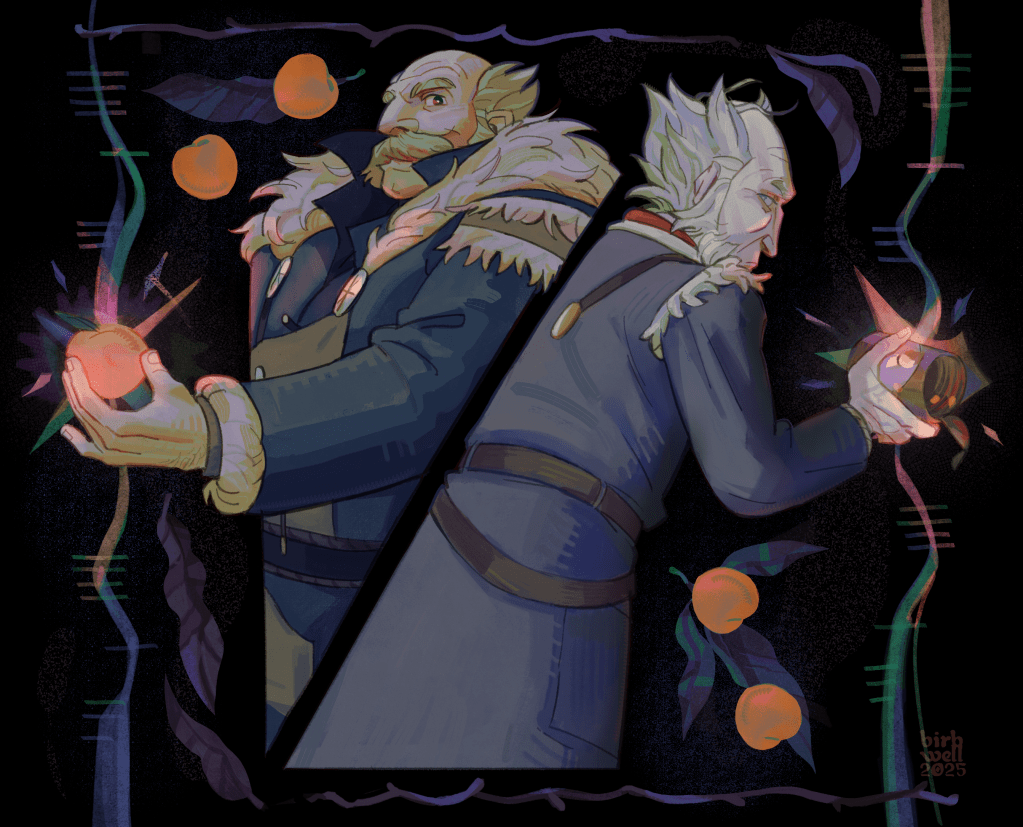
Artist: Birbwell
“The ogham on this piece says Eat :)”
Links: Birbwell on Bluesky / Birbwell on Tumblr
If you would like your work featured on our blog and social media, contact me:
Email: jess@saltstonestudios.com
Discord: jessanight
Thanks so much for your support, from The Pale Beyond to The Hearth and Harbour, and hopefully, beyond.
 saltstonestudios.com